
 By Graham Fisher
Updated November 2026
Finding the biggest solar generator for home backup means matching battery capacity and inverter output to what your household actually needs during an outage. A refrigerator, a CPAP machine and a sump pump draw very different amounts of power, and a unit that handles one may struggle with the others. The seven models below were compared on usable watt-hour capacity, continuous AC output, surge handling, charging speed, expandability and the consistency of owner feedback. Each one is a large portable power station or a battery system designed to run circuits in a home, not a camping-sized gadget.
Our top picks at a glance
- 1
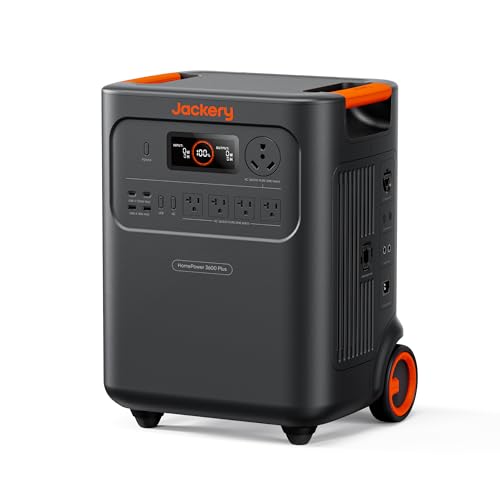 TOP CHOICEBest overallJackery HomePower 3600 Plus Power StationView on Amazon
- 2
 TOP CHOICEBest for whole-house expansionEF EcoFlow TITAN 5000 Classic Power StationView on Amazon
- 3
 TOP CHOICEBest for high-draw appliancesEF ECOFLOW DELTA 3 Max Portable Power StationView on Amazon
- 4
 Best for long outages with solar inputABOK Ark3600 Portable Power Station with 400W Solar PanelView on Amazon
- 5
 Best for essential-circuit backupJackery Solar Generator 1000 v2 and 200W Solar PanelView on Amazon
- 6
 Best for a compact upgradeJackery Explorer 1000 v2 Portable Power StationView on Amazon
- 7
 Best budget pickHOWEASY Portable Power StationView on Amazon
Our Top Picks
Quick Comparison
| Product | Best for | Key feature |
|---|---|---|
| Jackery HomePower 3600 Plus Power Station | Whole-home backup with high surge loads | 3584Wh LFP battery, 3600W AC output, expandable |
| EF EcoFlow TITAN 5000 Classic Power Station | Large homes and multi-day outages | 5017Wh LiFePO4 battery, 4000W AC output, scalable to 30kWh |
| EF ECOFLOW DELTA 3 Max Portable Power Station | Heavy appliances on essential circuits | 2048Wh LFP battery, 2400W output with 3400W X-Boost |
| ABOK Ark3600 Portable Power Station with 400W Solar Panel | Extended outages with solar recharge | 3840Wh LiFePO4 battery, expandable to 11520Wh, 2000W solar input |
| Jackery Solar Generator 1000 v2 and 200W Solar Panel | Refrigerator, medical devices and lighting | 1024Wh LiFePO4 battery, 1500W output, 10ms UPS switching |
| Jackery Explorer 1000 v2 Portable Power Station | Compact backup without a panel kit | 1024Wh LiFePO4 battery, 50-minute fast charge |
| HOWEASY Portable Power Station | Light loads such as phones, lamps and a small fan | 88Wh lithium battery, 120W output |
Jackery HomePower 3600 Plus Power Station
Jackery HomePower 3600 Plus Power Station, 3584Wh, 3600W AC Output | LFP Battery, Expandable to 21kWh, Solar Generator, Essential Home Backup for Home Use, Emergencies, RV (Solar Panel Optional)
Best for: Whole-home backup with high surge loads
This is the model most households with a refrigerator, a well pump and a few lighting circuits should look at first. Its roughly 3.6kW continuous output covers the startup surges of motors that smaller units cannot handle, and the listing states the battery can be expanded for longer runtimes.
Key specs
- 3584Wh LFP battery capacity
- 3600W AC output
- Expandable battery capacity (per manufacturer listing)
Pros
- Enough continuous output for most sump pumps and well pumps
- LFP chemistry is generally associated with long cycle life
- Expansion path for longer outages
Cons
- Large and heavy for a portable unit; plan for a fixed location
- Solar panels are optional and sold separately, so a full kit costs more to set up
Bottom line: A strong choice for homeowners who want the most capable single unit for essential circuits and motor loads.
View on AmazonEF EcoFlow TITAN 5000 Classic Power Station
EF EcoFlow TITAN 5000 Classic Power Station, 5017Wh, 4000W AC Output | LiFePO4 Battery, 5–30kWh Expandable Capacity, <30 dB, <20 ms Switchover with SHP10, Solar Generator for Home Backup,Emergency
Best for: Large homes and multi-day outages
The TITAN 5000 is aimed at people who think in terms of whole-house backup rather than a few circuits. Its listing emphasizes expandable capacity and a very fast switchover when used with a compatible transfer accessory, which matters for sensitive electronics.
Key specs
- 5017Wh LiFePO4 battery capacity
- 4000W AC output
- Expandable capacity from 5 to 30kWh (per listing)
Pros
- Very large base capacity for multi-day runtime
- Scalable as your needs grow
- Quiet operation rated below 30 dB per the listing
Cons
- Significant weight and footprint; professional installation is often advisable
- Full benefit depends on additional accessories, which add complexity
Bottom line: Best for households prepared to invest in a serious, expandable system that can carry most of a house through extended outages.
View on AmazonEF ECOFLOW DELTA 3 Max Portable Power Station
EF ECOFLOW DELTA 3 Max Portable Power Station, 2048Wh LFP Battery, 2400W | 3400W X-Boost Output, Ultra-Fast 0-80% Charging in 1.13 Hr, Home Backup & RV Camping, Solar Generator (Solar Panel Optional)
Best for: Heavy appliances on essential circuits
The DELTA 3 Max sits between a compact power station and a whole-home system. It suits a household that wants to run a refrigerator, a microwave on a short cycle and a few other loads without moving to a permanent installation.
Key specs
- 2048Wh LFP battery capacity
- 2400W continuous output, 3400W X-Boost (per listing)
- Fast charging rated at 0–80% in about 1.13 hours (per listing)
Pros
- Strong output for its battery size
- Fast recharge shortens the time back to full power
- Relatively manageable size for a unit of this capacity
Cons
- Capacity is smaller than the 5000-class systems for multi-day outages
- Solar panels are optional and sold separately
Bottom line: A balanced option for homeowners who need high output and fast recharging without committing to a whole-house system.
View on AmazonABOK Ark3600 Portable Power Station with 400W Solar Panel
ABOK Ark3600 Portable Power Station with 400W Solar Panel,2000W Solar Input | 3840Wh LiFePO4 Battery, Expandable to 11520Wh,15 Outlets, 3600W Solar Generator for Home Backup, Hurricane, Camping, RV
Best for: Extended outages with solar recharge
This bundle pairs a 3840Wh LiFePO4 battery with a 400W panel, which makes it a practical choice for people in areas where outages stretch across sunny days. The listing describes expansion up to 11520Wh, which gives room to grow.
Key specs
- 3840Wh LiFePO4 battery capacity
- 3600W output (per listing)
- Expandable to 11520Wh (per listing)
- 2000W solar input (per listing)
Pros
- Solar panel included in the bundle
- Large capacity with an expansion path
- Multiple outlets for several devices at once
Cons
- Recharge speed from a single 400W panel is limited by sunlight; expect slow solar recovery on cloudy days
- Less established brand footprint than some competitors; check warranty terms carefully
Bottom line: Good for households that want a solar-ready bundle and plan to add capacity over time.
View on AmazonJackery Solar Generator 1000 v2 and 200W Solar Panel
Jackery Solar Generator 1000 v2 and 200W Solar Panel,1024Wh LiFePO4 Battery | 1500W (3000W Peak), 50-Min Fast Charge, 10ms UPS Solar Generator for Home Emergency, Camping & RV
Best for: Refrigerator, medical devices and lighting
This kit combines a 1024Wh power station with a 200W panel, so it is aimed at keeping essential loads running rather than the whole house. The UPS-style switching rated at 10ms is useful for devices that should not lose power even briefly.
Key specs
- 1024Wh LiFePO4 battery capacity
- 1500W continuous output (3000W peak, per listing)
- 10ms UPS switching (per listing)
Pros
- Panel included, so setup is straightforward
- Quick switchover suits sensitive electronics
- Suitable for a refrigerator plus lighting and phone charging
Cons
- 1024Wh base capacity gives limited runtime for larger loads
- A 200W panel recharges slowly in cloudy conditions
Bottom line: A sensible choice for keeping the fridge, a CPAP and lights going through a typical outage.
View on AmazonJackery Explorer 1000 v2 Portable Power Station
Jackery Explorer 1000 v2 Portable Power Station, 1024Wh LiFePO4 Battery | 1500W (3000W Peak), 50-Min Fast Charge, 10ms UPS Solar Generator for Home Emergency, Camping & RV.
Best for: Compact backup without a panel kit
This is the same core power station as the solar kit above, sold without a panel. It suits someone who already owns solar panels or plans to charge from a wall outlet during outages.
Key specs
- 1024Wh LiFePO4 battery capacity
- 1500W continuous output (3000W peak, per listing)
- 50-minute fast charge (per listing)
Pros
- Fast recharge from a wall outlet
- Easy to move between rooms or vehicles
- Lets you choose your own solar panels
Cons
- No panel included, so a solar setup adds cost and planning
- Same 1024Wh limit applies to runtime
Bottom line: Best for households that want a compact unit and already have, or plan to buy, separate solar hardware.
View on AmazonHOWEASY Portable Power Station
HOWEASY Portable Power Station,120W(240W Peak) Solar Generator | 88Wh Lithium Battery Power with 110V AC Outlet/DC/USB/LED Light for Outdoor Camping Trip Hunting Emergency
Best for: Light loads such as phones, lamps and a small fan
This is the smallest unit on the list and is not a true whole-home backup source. It fits people who need to keep phones, a router, LED lights and a small fan running, or who want a low-cost entry point to backup power.
Key specs
- 88Wh lithium battery capacity
- 120W continuous output (240W peak, per listing)
- 110V AC, DC and USB outputs
Pros
- Simple to use with several output types
- Light enough to carry easily
- Useful for charging small devices during short outages
Cons
- Capacity is far too small for a refrigerator, pump or CPAP over a full night
- Not suitable as the main source for medical equipment
Bottom line: A budget pick for light device charging, not for serious home backup.
View on AmazonBuying Guide
Usable watt-hour capacity
Watt-hours (Wh) measure how much energy a battery stores. Multiply a device’s wattage by the hours you need it to run to estimate consumption. A refrigerator averaging around 150 watts over a day uses roughly 3.6kWh, so a 1000Wh unit will not cover it through a full day. Account for inverter losses, which typically reduce usable energy by some margin, and consider a battery of 3000Wh or more for overnight plus daytime needs.
Good picks for this: Jackery HomePower 3600 Plus Power Station, EF EcoFlow TITAN 5000 Classic Power Station
Continuous output and surge rating
Continuous wattage is what the unit can supply indefinitely. Surge or peak wattage is what it can deliver briefly when a motor starts. Sump pumps, well pumps and some air conditioners have startup surges several times their running draw. Check that the peak rating comfortably exceeds the largest motor you plan to run.
Good picks for this: EF ECOFLOW DELTA 3 Max Portable Power Station, Jackery HomePower 3600 Plus Power Station
Battery chemistry
Most current large units use lithium iron phosphate (LFP or LiFePO4) batteries. Manufacturers generally describe this chemistry as offering more charge cycles and better thermal stability than older lithium-ion designs. Longer cycle life matters if you expect to cycle the battery through frequent outages or daily solar use.
Good picks for this: Jackery Solar Generator 1000 v2 and 200W Solar Panel, ABOK Ark3600 Portable Power Station with 400W Solar Panel
Expandability
If your outage needs might grow, look for a system that accepts additional battery modules. Expansion lets you raise runtime without replacing the whole unit. Confirm which expansion batteries are compatible with the exact model before buying.
Good picks for this: EF EcoFlow TITAN 5000 Classic Power Station, ABOK Ark3600 Portable Power Station with 400W Solar Panel
Solar recharge capability
Solar input rating and panel wattage determine how fast the battery recovers. A 400W panel in full sun will recharge far faster than a 200W panel, but real output depends on sunlight, angle and weather. Plan for slower recharging in winter and during extended cloudy periods, and consider how many panels your roof or yard can support.
Good picks for this: Jackery Explorer 1000 v2 Portable Power Station, ABOK Ark3600 Portable Power Station with 400W Solar Panel
Size, weight and placement
Units above roughly 3kWh are heavy and often better suited to a fixed spot in a garage or utility room than to frequent moving. Plan ventilation and keep the unit away from water and direct heat. Measure the space and confirm that a two-person lift is feasible if you need to reposition it.
Good picks for this: Jackery HomePower 3600 Plus Power Station, EF EcoFlow TITAN 5000 Classic Power Station
Outlets and transfer method
Count the outlets and output types you need, including 240V circuits if you want to run an appliance such as an electric range or dryer. Confirm whether the unit can connect to a home circuit through a transfer switch or dedicated accessory, and whether it offers UPS-style switchover for electronics.
Good picks for this: Jackery Solar Generator 1000 v2 and 200W Solar Panel, EF ECOFLOW DELTA 3 Max Portable Power Station
FAQ
What size solar generator do I need to run a refrigerator during an outage?
A typical refrigerator may use roughly 1 to 2 kWh per day depending on its age, efficiency and how often the door opens. A unit with at least 2000Wh of usable capacity can often cover that for a day, and larger systems extend the time. Check your appliance’s energy label and track usage with a plug-in meter to refine the estimate.
Can a portable solar generator run a sump pump?
Many can, provided the continuous output and surge rating exceed the pump’s requirements. Pumps often draw more at startup, so look at the surge figure. Because sump pumps are critical during flooding, consult an electrician or the pump manufacturer before relying on any backup system.
How long will a 3600Wh battery last?
Runtime depends entirely on the load. A device drawing 100 watts would run roughly 30 hours in theory, but real-world losses reduce that. Add up your essential loads, divide the usable watt-hours by that total, and reduce the result for inverter inefficiency.
Do I need solar panels with a large power station?
Not always. A power station can recharge from a wall outlet or a generator. Solar panels become valuable when outages are long, when grid power is unavailable for days, or when you want to reduce dependence on fuel. Panels also add to setup complexity and weather sensitivity.
Is a portable power station safe to use indoors?
Battery-based units produce no combustion exhaust, which is a major safety advantage over gasoline generators. Still, follow the manufacturer’s guidance on ventilation, keep the unit dry, and never connect it to a home circuit without a proper transfer switch or qualified installation. For a permanent connection, consult a licensed electrician.
How long do LiFePO4 batteries last?
Manufacturers commonly specify cycle life in the thousands of charge cycles, depending on depth of discharge and temperature. Actual lifespan varies with use, storage conditions and maintenance. Check the warranty and the cycle-life rating in the product documentation.
Should I buy a whole-home system or a portable unit?
A portable unit is flexible and easier to install, but it powers selected loads. A whole-home system, often installed with a transfer switch, can run more of the house but requires professional installation and higher upfront planning. Many households combine a portable unit for essentials with a larger system for critical circuits.
Conclusion
For most homeowners asking about the biggest solar generator for home backup, the Jackery HomePower 3600 Plus Power Station and the EF EcoFlow TITAN 5000 Classic Power Station stand out for capacity and output. The Jackery HomePower suits households focused on essential circuits and motor loads, while the TITAN 5000 fits those planning for longer outages and possible expansion. The EF ECOFLOW DELTA 3 Max and ABOK Ark3600 offer strong middle-ground options with fast recharging or bundled solar. The smaller Jackery units and the HOWEASY station are better for limited needs. Calculate your daily watt-hour use before choosing, and consult a licensed electrician for any permanent connection to your home’s electrical system.
Sources
- Guidance on home energy use, backup power planning and efficiency labeling (energy.gov)
- Consumer safety guidance on portable generators, batteries and electrical products (cpsc.gov)
- Fire and electrical safety standards relevant to battery storage and home power systems (nfpa.org)
Related reading
- Portable Solar Generator vs Home Battery System
- Large Solar Generators (5000W and Up): Whole-Home Backup Basics
- Home Backup With a Solar Generator: What It Can Power and How to Connect Safely
- Best Solar Generators for Home Backup
- Wind Generator vs Solar Panels: Which Fits Your Home Backup Needs?
About Graham Fisher
Graham Fisher is part of our editorial team and reviews and edits our solar generators for home backup & emergencies guides, checking product details against manufacturer specifications and owner feedback.


