
 By Graham Fisher
Updated November 2026
Shopping for the largest Jackery solar generator usually starts with one question: how much power does my home actually need when the grid goes down? This guide narrows the Jackery lineup to four models that span light backup to whole-house-style loads, and it explains how to judge each one. The selection criteria are battery capacity in watt-hours, continuous AC output in watts, surge handling for motor-driven appliances, solar input and recharge options, and how well each model fits real outage scenarios. Everything here is based on manufacturer specifications, brand reputation and common patterns in owner feedback. We have not run these units ourselves.
Our top picks at a glance
- 1
 TOP CHOICEBest overallJackery Solar Generator 1000 v2 and 200W Solar PanelView on Amazon
- 2
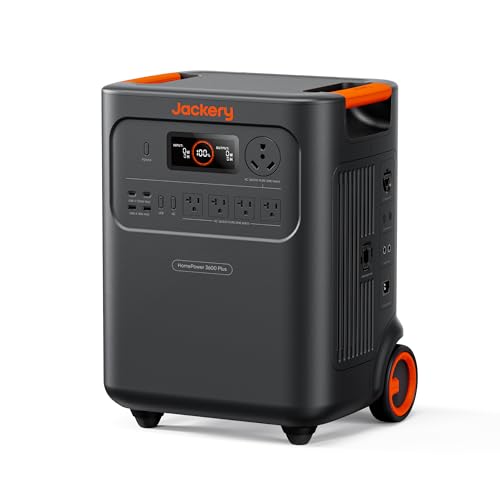 Best for whole-home capacityJackery HomePower 3600 Plus Power StationView on Amazon
- 3
 Best for small kitchens and essential loadsJackery Explorer 300 Portable Power StationView on Amazon
- 4
 Best for heavier appliances and mixed loadsJackery Explorer 2000 v2 Portable Power StationView on Amazon
Our Top Picks
| Product | Best for | Key feature |
|---|---|---|
| Jackery Solar Generator 1000 v2 and 200W Solar Panel | Balanced home backup and bundled solar recharging | 1,024Wh LiFePO4 battery with a bundled 200W panel |
| Jackery HomePower 3600 Plus Power Station | Largest capacity for extended home outages | 3,584Wh LFP battery and 3,600W AC output, expandable |
| Jackery Explorer 300 Portable Power Station | Small kitchens, CPAP and lighting | 292Wh LiFePO4 battery in a compact body |
| Jackery Explorer 2000 v2 Portable Power Station | Mid-to-large loads with higher surge needs | 2,042Wh LiFePO4 battery and 2,200W AC output |
Jackery HomePower 3600 Plus Power Station
Jackery HomePower 3600 Plus Power Station, 3584Wh, 3600W AC Output | LFP Battery, Expandable to 21kWh, Solar Generator, Essential Home Backup for Home Use, Emergencies, RV (Solar Panel Optional)
Best for: Largest capacity for extended home outages
This is the model to consider if your goal is to keep a broader set of household circuits alive for longer. Homeowners who want to run a refrigerator, a sump pump, network gear and lighting through a multi-day outage tend to look at this capacity tier first.
Key specs
- 3,584Wh LFP battery capacity
- 3,600W AC output
- Expandable battery capacity, per the listing name (up to 21kWh with add-on batteries)
- Solar panel optional
Pros
- Highest energy capacity in this lineup
- High AC output handles multiple appliances at once
- Expansion path for longer or heavier backup needs
Cons
- Larger and heavier than portable units, so placement needs planning
- Solar panels are sold separately, which adds setup planning
Bottom line: Best suited to households that want the most runtime for essential circuits and may expand later.
View on AmazonJackery Solar Generator 1000 v2 and 200W Solar Panel
Jackery Solar Generator 1000 v2 and 200W Solar Panel,1024Wh LiFePO4 Battery | 1500W (3000W Peak), 50-Min Fast Charge, 10ms UPS Solar Generator for Home Emergency, Camping & RV
Best for: Balanced home backup with bundled solar recharging
This kit suits people who want a ready-to-use setup with a solar panel included, and who need a meaningful but not oversized battery for refrigerators, CPAP machines and phone or router charging during outages.
Key specs
- 1,024Wh LiFePO4 battery
- 1,500W rated AC output (3,000W peak), per the listing name
- 200W solar panel included
- Fast-charge and UPS-style switchover, per the listing name
Pros
- Solar panel included in the kit
- Good balance of capacity and portability
- Peak output handles short motor startup surges
Cons
- Capacity is modest for whole-house use over several days
- A single 200W panel recharges slowly in cloudy or winter conditions
Bottom line: A strong choice for apartments or smaller homes that want essential-circuit backup with solar recharging included.
View on AmazonJackery Explorer 2000 v2 Portable Power Station
Jackery Explorer 2000 v2 Portable Power Station, 2042Wh, 2200W AC Output | LiFePO4 Battery, USB-C PD 100W Fast Charging, Solar Generator for Emergencies, Power Outages, Camping (Solar Panel Optional)
Best for: Heavier appliances and mixed loads
Owners who need more output headroom than a small station provides, such as running a microwave, power tools or a window air conditioner for part of the day, often look at this mid-to-large tier.
Key specs
- 2,042Wh LiFePO4 battery
- 2,200W AC output
- USB-C PD 100W fast charging, per the listing name
- Solar panel optional
Pros
- Higher AC output than the smaller Explorer models
- Substantially more capacity than the 1000-class unit
- Fast USB-C charging for laptops and phones
Cons
- Heavier to move than the compact Explorer 300
- Solar panels are a separate purchase
Bottom line: A practical middle option for households that need more output than a basic station but do not require the full capacity of the HomePower 3600 Plus.
View on AmazonJackery Explorer 300 Portable Power Station
Jackery Explorer 300 Portable Power Station,292Wh | Backup LiFePO4 Battery, Solar Generator for Outdoors, Camping, Travel, Hunting, Blackout (Solar Panel Optional)
Best for: Small kitchens and essential loads
This is the smallest unit in the set and suits people who only need to keep a few low-draw devices running, such as a CPAP machine, LED lights, a router and phone chargers.
Key specs
- 292Wh LiFePO4 battery
- Solar panel optional
- Compact, portable form factor
Pros
- Lightweight and easy to store
- Suitable for CPAP-type loads for a few hours
- Quick to set up with no installation
Cons
- Too small for refrigerators running through long outages
- Limited capacity means frequent recharging
Bottom line: Best for light emergency use, not whole-kitchen backup. Pick it if your loads are minimal.
View on AmazonBuying Guide
Battery capacity (watt-hours)
Watt-hours (Wh) measure how much energy a battery stores. To estimate runtime, divide the battery’s Wh by the appliance’s average wattage, then account for inverter losses, which commonly reduce usable energy by roughly 10 to 20 percent. A 1,000Wh battery running a 100W load will deliver about 8 to 9 hours in practice, not the full 10.
Good picks for this: Jackery Solar Generator 1000 v2 and 200W Solar Panel, Jackery HomePower 3600 Plus Power Station
Continuous and peak AC output
Continuous wattage is what the unit can supply indefinitely. Peak or surge wattage covers the brief spike motors need on startup. Check that the continuous rating exceeds the combined running wattage of everything you plan to run at once. Refrigerators and sump pumps often need two to three times their running wattage at startup.
Good picks for this: Jackery Explorer 2000 v2 Portable Power Station, Jackery Solar Generator 1000 v2 and 200W Solar Panel
Sizing for your actual loads
List each device, its wattage (found on the label or manual), and how many hours per day it runs. A CPAP machine might draw 30 to 60W for 8 hours, while a refrigerator cycles on and off and averages far less than its nameplate rating. Add up daily watt-hours, then choose a battery that covers at least one full day with margin. Consult an electrician before connecting any unit to home circuits, and never backfeed a standard outlet.
Good picks for this: Jackery HomePower 3600 Plus Power Station, Jackery Explorer 300 Portable Power Station
Solar input and recharge time
Solar recharge time depends on panel wattage, sun hours and weather. A 200W panel in good sun might deliver several hours of usable charging per day, but output drops sharply on cloudy days. Confirm the maximum solar input the unit accepts so you can match panels correctly.
Good picks for this: Jackery Solar Generator 1000 v2 and 200W Solar Panel, Jackery Explorer 2000 v2 Portable Power Station
Battery chemistry and lifespan
LiFePO4 and LFP batteries are widely used in home backup units because they tolerate many more charge cycles than older lithium-ion chemistries. Manufacturers typically specify cycle life in the thousands at a set depth of discharge. Lifespan also depends on storing the unit in moderate temperatures and avoiding repeated full discharges.
Good picks for this: Jackery HomePower 3600 Plus Power Station, Jackery Explorer 300 Portable Power Station
Portability and placement
A large unit may be too heavy to move easily. If you plan to keep it in a garage or basement and move it occasionally, weigh the unit and confirm the space can handle it. Keep it in a dry, ventilated location away from direct heat.
Good picks for this: Jackery Explorer 300 Portable Power Station, Jackery Explorer 2000 v2 Portable Power Station
Expandability and future needs
If your needs may grow, look for models that support additional battery modules or pair with more panels. This avoids replacing the whole system later. Estimate your needs for the next few years, not just today.
Good picks for this: Jackery HomePower 3600 Plus Power Station, Jackery Solar Generator 1000 v2 and 200W Solar Panel
FAQ
What is the largest Jackery solar generator for home backup?
Among the models covered here, the Jackery HomePower 3600 Plus Power Station has the highest listed capacity at 3,584Wh with 3,600W AC output, and it is expandable according to its listing.
How long will a Jackery run a refrigerator?
It depends on the refrigerator’s average daily consumption, which is often far lower than its nameplate rating. As a rough guide, many modern refrigerators use a few hundred watt-hours per day. Check your appliance’s energy label and use the battery’s Wh rating, minus losses, to estimate runtime.
Can a Jackery power a CPAP machine overnight?
Many CPAP machines draw relatively low power, so smaller units such as the Explorer 300 can support them for part of a night. Confirm your machine’s wattage and consult your doctor or sleep provider before relying on backup power for medical equipment.
Do I need a solar panel to use these units?
No. Each unit can be charged from a wall outlet or vehicle source, and solar is an additional recharge option. For extended outages, solar panels help extend runtime, but output depends on weather.
Can these units power a sump pump?
Sump pumps have high startup surges, so the unit’s peak output matters. Confirm the pump’s rated wattage and surge requirement, and consult a licensed electrician about safe connection, especially if the pump is wired to a dedicated circuit.
Is LiFePO4 safer than other lithium batteries?
LiFePO4 chemistry is generally regarded as more thermally stable than some other lithium-ion chemistries, which is one reason it is common in home backup products. Always follow the manufacturer’s storage and charging guidance.
Conclusion
The largest option here, the HomePower 3600 Plus, fits households that want the most runtime and possible expansion. The 1000 v2 kit works well for essential circuits with solar included. The Explorer 2000 v2 suits heavier mixed loads, and the Explorer 300 is best for minimal loads like a CPAP and lighting. Match capacity and surge output to your own load list before you buy.
Sources
- Guidance on home energy use, backup power planning and battery safety (energy.gov)
- Consumer safety information on portable power equipment and battery hazards (cpsc.gov)
- Fire safety standards and guidance for lithium battery storage and charging (nfpa.org)
Related reading
- Jackery Solar Generator for House: 6 Best Picks Compared (2026)
- Jackery Solar Generator HomePower 3000: 5 Best Picks Compared (2026)
- Jackery Solar Generator Home Power 3000: 4 Best Options Compared (2026)
- Jackery Solar Generator 5000 Plus Review: Features and Performance
- Jackery HomePower 3600 Plus Solar Generator: 5 Best Picks Compared (2026)
- Jackery Explorer 2026 Plus Solar Generator: 5 Best Picks Compared (2026)
About Graham Fisher
Graham Fisher is part of our editorial team and reviews and edits our solar generators for home backup & emergencies guides, checking product details against manufacturer specifications and owner feedback.




