
 By Graham Fisher
Updated November 2026
Choosing the most powerful solar generator for home use comes down to one question: how many watts can it deliver when your refrigerator, CPAP, sump pump and lights all want power at once? Power output (continuous and surge), battery capacity in watt-hours, expandability, solar input and the number of outlets that can handle a 240V appliance all matter here. The five picks below were selected from manufacturer specifications, brand track record and recurring themes in owner feedback. We did not test these units ourselves, so check current listings before you buy.
Our top picks at a glance
- 1
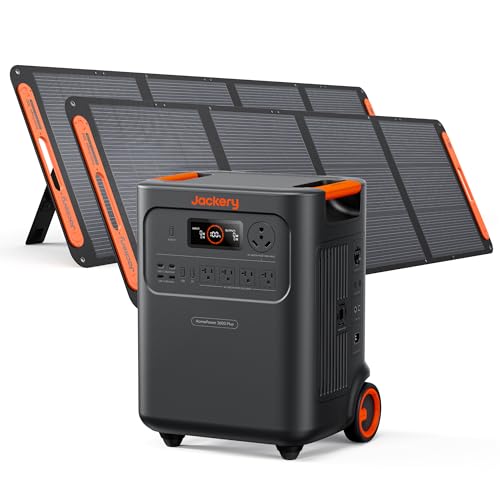 TOP CHOICEBest overallJackery HomePower 3600 Plus & 2x200W Solar PanelsView on Amazon
- 2
 TOP CHOICEBest for whole-home expansionABOK Ark3600 Portable Power Station with 3×200W Solar PanelsView on Amazon
- 3
 TOP CHOICEBest for fast rechargingJackery Solar Generator 1000 v2 and 200W Solar PanelView on Amazon
- 4
 Best for small kitchens and essentialsJackery Explorer 300 Portable Power Station,292WhView on Amazon
- 5
 Best budget pickPortable Solar Generator 300W Portable Power Station with 60W Solar PanelView on Amazon
Our Top Picks
| Product | Best for | Key feature |
|---|---|---|
| Jackery HomePower 3600 Plus | Whole-home essentials backup | 3600W AC output with 3584Wh LFP battery, expandable to 21kWh |
| ABOK Ark3600 Portable Power Station | Long outages and RV-style hookups | 3840Wh battery, 3600W output, expandable to 11520Wh |
| Jackery Solar Generator 1000 v2 | Fast recharging | 1500W output, 50-minute fast charge, 10ms UPS switchover |
| Jackery Explorer 300 Portable Power Station | Small kitchens and medical devices | 292Wh LiFePO4 battery in a compact body |
| Portable Solar Generator 300W Portable Power Station | Budget backup for a few devices | 280Wh battery with 110V pure sine wave output |
Jackery HomePower 3600 Plus & 2x200W Solar Panels
Jackery HomePower 3600 Plus & 2x200W Solar Panels, 3584Wh, 3600W AC Output | LFP Battery, Expandable to 21kWh, Solar Generator, Essential Home Backup for Home Use, Emergencies, RV
Best for: Whole-home essentials backup
This is the pick for households that want to keep a refrigerator, well pump, lights, Wi-Fi and a CPAP running through a multi-day outage without rationing. Its rated output is high enough to handle most standard household loads.
Key specs
- 3600W AC output
- 3584Wh LFP (lithium iron phosphate) battery
- Includes two 200W solar panels
- Expandable to about 21kWh with additional battery modules
Pros
- Enough continuous output for most standard household circuits
- Expandable battery capacity for longer outages
- LFP chemistry is generally associated with a long cycle life
Cons
- Large and heavy compared with portable units, so placement needs planning
- Full expansion adds significant cost over the base kit
Bottom line: Best suited to homeowners who want the highest output and room to grow, and who have a fixed spot for the unit.
View on AmazonABOK Ark3600 Portable Power Station with 3×200W Solar Panels
ABOK Ark3600 Portable Power Station with 3×200W Solar Panels, 3840Wh 3600W | 2H Fast Charge, 15 Ports, TT-30 RV Port, Expandable to 11520Wh, Solar Generator for Home Backup, RV, Camping
Best for: Long outages and RV-style hookups
This unit suits buyers who expect extended outages or want a path to very large storage. The listing advertises a TT-30 RV port, which also makes it useful outside the house.
Key specs
- 3600W output rating
- 3840Wh battery capacity
- Three 200W solar panels included
- Expandable to 11520Wh according to the listing
Pros
- Large base battery with strong expansion potential
- Many outlets, including a TT-30 port
- Three solar panels give more daytime input than most kits at this size
Cons
- Heavy, so it is not practical to carry
- Brand reputation is less established than the Jackery lineup, so compare warranty terms carefully
Bottom line: A good match for households planning a long-term backup setup or those who want RV-compatible hookups as well.
View on AmazonJackery Solar Generator 1000 v2 and 200W Solar Panel
Jackery Solar Generator 1000 v2 and 200W Solar Panel,1024Wh LiFePO4 Battery | 1500W (3000W Peak), 50-Min Fast Charge, 10ms UPS Solar Generator for Home Emergency, Camping & RV
Best for: Fast recharging
Homeowners who want to restore a depleted battery in a single sunny day, or who need quick switchover during an outage, will find this model’s charging speed and UPS response the main draw.
Key specs
- 1500W continuous output (3000W peak)
- 1024Wh LiFePO4 battery
- 50-minute fast charge rating
- 10ms UPS switchover, per the listing
Pros
- Fast charging shortens recovery time between outages
- Rated switchover time suits sensitive electronics
- Strong surge rating for motor loads
Cons
- Battery capacity is modest for multi-day whole-house use
- Limited expansion compared with the larger kits
Bottom line: Best for buyers who value fast recharge and quick switchover over raw storage size.
View on AmazonJackery Explorer 300 Portable Power Station,292Wh
Jackery Explorer 300 Portable Power Station,292Wh | Backup LiFePO4 Battery, Solar Generator for Outdoors, Camping, Travel, Hunting, Blackout (Solar Panel Optional)
Best for: Small kitchens and medical devices
This compact unit fits buyers who only need to run a few essentials, such as a small refrigerator, phone charging, lights and a CPAP. It is also easy to move between rooms during a power cut.
Key specs
- 292Wh LiFePO4 battery
- Compact, portable form factor
- Solar panel sold separately as an option
Pros
- Light enough to carry from room to room
- LFP battery chemistry is widely regarded as durable
- Simple setup with no installation needed
Cons
- Capacity is too small for whole-home loads or long outages
- Solar panels are an extra purchase
Bottom line: A practical choice for apartments and small homes that only need to keep critical items running.
View on AmazonPortable Solar Generator 300W Portable Power Station with 60W Solar Panel
Portable Solar Generator 300W Portable Power Station with 60W Solar Panel | 110V Pure Sine Wave 280Wh Battery Solar Power Pack with USB QC3.0 DC AC Outlet for Camping Smart Device RV Van Outdoor-Orang
Best for: Budget backup for a few devices
Buyers looking for a low-entry option to power phones, a router, a fan and a small light during a short outage will find this unit covers the basics. It is not a whole-home solution.
Key specs
- 300W output rating
- 280Wh battery
- 110V pure sine wave AC output
- 60W solar panel included
Pros
- Pure sine wave output is safer for most electronics
- Includes a solar panel in the box
- Multiple USB and DC ports
Cons
- Output is too low for refrigerators, sump pumps or well pumps with startup surges
- Small battery means short runtime on higher loads
Bottom line: Suited to light, short-term backup for electronics rather than major household appliances.
View on AmazonBuying Guide
Continuous and surge wattage
Continuous wattage is the load the unit can sustain. Surge (peak) wattage covers the brief startup spike of motors in refrigerators and sump pumps, which can be several times their running draw. Check the surge rating against the highest-starting appliance you plan to run.
Good picks for this: Jackery HomePower 3600 Plus, Jackery Solar Generator 1000 v2
Battery capacity in watt-hours
Watt-hours (Wh) determine runtime. Divide the battery capacity by the average load in watts to estimate hours of backup, then reduce that figure by about 10–20% to account for conversion losses. A 3,600Wh battery running a 300W average load gives roughly 10 hours in practice.
Good picks for this: ABOK Ark3600 Portable Power Station, Jackery HomePower 3600 Plus
Battery chemistry
Lithium iron phosphate (LFP or LiFePO4) batteries are commonly associated with longer cycle life and better thermal stability than some other lithium chemistries. Confirm the chemistry in the specifications before buying.
Good picks for this: Jackery Explorer 300 Portable Power Station, Jackery Solar Generator 1000 v2
Expandability
If you may want more runtime later, check whether the unit accepts add-on battery modules and the maximum total capacity. Expansion can be far cheaper than buying a second unit, but confirm compatibility with the exact model.
Good picks for this: ABOK Ark3600 Portable Power Station, Jackery HomePower 3600 Plus
Solar input and recharge time
Solar input is measured in watts, and real output depends on sun exposure, panel angle and weather. Plan on roughly half of the rated panel output on average over a day. Also note the AC or wall charging rate, since it is often the faster option when grid power returns.
Good picks for this: Jackery Solar Generator 1000 v2, Portable Solar Generator 300W Portable Power Station
Outlets and transfer switching
Count the outlets you need and check whether any 240V appliances (such as a well pump or electric range) are involved. Running household circuits through a generator usually requires a licensed electrician and a transfer switch to prevent backfeeding the grid.
Good picks for this: ABOK Ark3600 Portable Power Station, Jackery HomePower 3600 Plus
Portability and placement
Heavy units are better kept in a fixed spot with ventilation. Never run a power station indoors in a closed space, and keep it away from water and heat sources.
Good picks for this: Jackery Explorer 300 Portable Power Station, Portable Solar Generator 300W Portable Power Station
FAQ
What is the most powerful solar generator for home backup?
Among the five models here, the Jackery HomePower 3600 Plus and the ABOK Ark3600 both list 3600W output and battery capacities above 3,500Wh, making them the highest-capacity options on this list. Power ratings and expansion options should be checked against your actual loads.
How many watts do I need to run a refrigerator during an outage?
Most refrigerators run at roughly 100–200W on average but can spike several times higher when the compressor starts. Check the nameplate and choose a unit with surge capacity above that starting figure.
Can a solar generator run a CPAP machine?
Many CPAP machines draw modest power, often well under 100W, so a small unit can handle them for a night. Confirm the device’s wattage on its label and consult your sleep provider or medical supplier about backup planning.
Will a sump pump work on a solar generator?
Sump pumps have startup surges, so the unit’s surge rating matters more than its battery size. Confirm the pump’s running and starting watts before relying on it during flooding, and consult a licensed professional for installation advice.
How long will a solar generator run a whole house?
Runtime depends on how much power your home draws. A 3,600Wh battery running an average 500W load lasts roughly 6 to 7 hours after conversion losses. Whole-home runtime for multi-day outages usually requires expansion and careful load management.
Do I need a transfer switch to connect a solar generator to my home wiring?
Yes, for safe whole-home use. A transfer switch prevents backfeeding into the utility grid, which can injure line workers. Have a licensed electrician install it.
Conclusion
For the most powerful solar generator for home backup, the Jackery HomePower 3600 Plus and the ABOK Ark3600 lead on output and capacity, with the Ark3600 offering the largest expansion path. The Jackery Solar Generator 1000 v2 suits buyers who prioritize fast recharging, while the Jackery Explorer 300 covers small kitchens and medical devices. The 300W budget unit is best kept for phones, lights and small electronics. Match the wattage and surge rating to your heaviest load, and confirm specifications on each listing before purchase.
Sources
- Guidance on home energy storage, backup power planning and generator safety (energy.gov)
- Consumer safety information on portable generators and carbon monoxide hazards (cpsc.gov)
- Electrical and standby power codes relevant to home backup installations (nfpa.org)
Related reading
- Wind Generator vs Solar Panels: Which Fits Your Home Backup Needs?
- Whole Home Solar Generator: 7 Best Picks for Backup Power in 2026
- Top 6 Solar Powered Steam Generators Compared for Home Use
About Graham Fisher
Graham Fisher is part of our editorial team and reviews and edits our solar generators for home backup & emergencies guides, checking product details against manufacturer specifications and owner feedback.



