
 By Graham Fisher
Updated November 2026
Pecron solar generator reviews help buyers sort through a crowded set of LiFePO4 power stations, but the right model depends on what you need to run during an outage. This guide compares five Pecron units based on listed capacity, continuous output, solar input, expandability and the use cases owners most often describe. The criteria are battery size, surge and continuous wattage, solar charging support, and how well each unit suits home backup versus portable use.
Our top picks at a glance
- 1
 TOP CHOICEBest overallPECRON Portable Power Station F3000LFP, 3072Wh Solar GeneratorView on Amazon
- 2
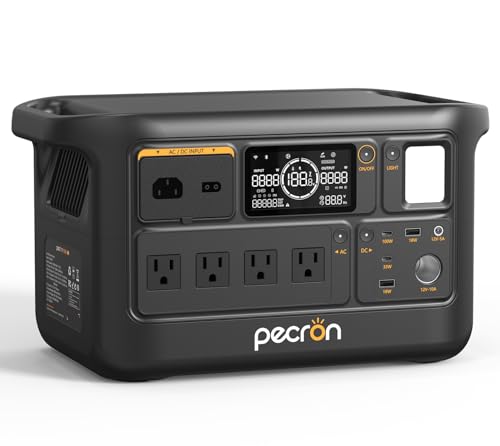 TOP CHOICEBest for small loads and campingPECRON F1000 LFP Portable Power Station 960Wh, 1500W Solar GeneratorView on Amazon
- 3
 TOP CHOICEBest for 240V whole-home backupOSCAL PowerMax 6000 Solar Generator with 3×400W Solar PanelView on Amazon
- 4
 Best for high-capacity expansion5120Wh Large Capacity 120V/240V Solar Generator, Portable Power Station P5000 PlusView on Amazon
- 5
 Best budget-friendly Jackery alternativeJackery Solar Generator 1000 v2 and 200W Solar Panel, 1024Wh LiFePO4View on Amazon
Our Top Picks
| Product | Best for | Key feature |
|---|---|---|
| PECRON F3000LFP | Whole-home backup | 3072Wh, expandable to 10752Wh |
| PECRON F1000 LFP | Small loads and camping | 960Wh, 1500W AC output |
| OSCAL PowerMax 6000 | 240V split-phase homes | 6000W AC, 3 solar panels |
| PowerStation P5000 Plus | Large battery needs | 5120Wh, 3600W AC output |
| Jackery Solar Generator 1000 v2 | Light emergency backup | 1024Wh, 10ms UPS switching |
PECRON Portable Power Station F3000LFP, 3072Wh Solar Generator
PECRON Portable Power Station F3000LFP, 3072Wh Solar Generator, 3600W LiFePO4 Battery Home Backup, Fast Charging Power Station Expand Capacity to 10752Wh, Solar Generators for Home Use, Camping, RV
Best for: Whole-home backup with room to grow.
This unit suits households that want to run a refrigerator, lights, a CPAP and internet gear through multi-day outages. Manufacturers specify 3600W AC output and expansion support.
Pros
- Large 3072Wh LiFePO4 battery with expansion listed to 10752Wh
- 3600W continuous output covers most household appliances
Cons
- Heavy enough that moving it between rooms takes planning
PECRON F1000 LFP Portable Power Station 960Wh, 1500W Solar Generator
PECRON F1000 LFP Portable Power Station 960Wh, 1500W Solar Generator | 1500W AC Output, LiFePO4 Battery Backup, Fast Charging Power Station for Camping, Home Use, RV, Emergency
Best for: Small loads and camping.
A good fit for a bedroom backup setup, phone and laptop charging, or a weekend trip. The 1500W AC rating covers most small appliances.
Pros
- Compact size for its battery capacity
- Fast charging keeps turnaround short between uses
Cons
- 960Wh runtime is too short for a full refrigerator overnight in many homes
OSCAL PowerMax 6000 Solar Generator with 3×400W Solar Panel
OSCAL PowerMax 6000 Solar Generator with 3×400W Solar Panel, 120V/240V Split Phase Voltage 6000W AC Outlets (9000W Peak), 2200W AC Charging/2400W Solar Charging, Emergency for Home, Battery Backup
Best for: 240V whole-home backup.
Homeowners with split-phase 120V/240V panels who want to power larger loads such as well pumps or electric ranges will find this unit’s listed output the most relevant.
Pros
- Split-phase 120V/240V output with 6000W AC rating
- Three 400W solar panels included for faster recharging
Cons
- Installation and panel compatibility should be checked before purchase
5120Wh Large Capacity 120V/240V Solar Generator, Portable Power Station P5000 Plus
5120Wh Large Capacity 120V/240V Solar Generator,Portable Power Station P5000 Plus With 2X400W Solar Panel,3600W AC Output (6000W Surge),1000W MPPT Solar for Emergency, Home Backup
Best for: Large battery needs.
Users planning longer outages or running multiple circuits will value the 5120Wh capacity. The 2×400W solar panel pairing is listed for daytime recharging.
Pros
- 5120Wh battery capacity is among the larger listed here
- 3600W AC output with 6000W surge rating
Cons
- Considerable weight limits portability
Jackery Solar Generator 1000 v2 and 200W Solar Panel, 1024Wh LiFePO4
Jackery Solar Generator 1000 v2 and 200W Solar Panel,1024Wh LiFePO4 Battery | 1500W (3000W Peak), 50-Min Fast Charge, 10ms UPS Solar Generator for Home Emergency, Camping & RV
Best for: Light emergency backup.
This unit is a practical pick for keeping a router, lights, phones and a small fan running during short outages. Its 10ms UPS switching is listed for devices sensitive to power interruption.
Pros
- 10ms UPS switching listed for sensitive electronics
- Fast charging support noted in the listing
Cons
- Limited runtime for high-draw appliances
Buying Guide
Match capacity to your critical loads
Add up the watt-hours each device uses per day, then compare that total against the battery’s listed Wh. Include a margin, since real runtime is lower than the rated number. A refrigerator often draws more than a phone or lamp over a full day.
Check continuous versus surge output
Continuous wattage is what the unit can supply indefinitely, while surge rating covers brief startup spikes from motors and compressors. Confirm the continuous rating exceeds the combined running wattage of your devices.
Consider solar input and charging time
Listed solar input determines how quickly the battery recharges in daylight. Weather, panel angle and shading all reduce real-world output, so plan for slower recharging than the maximum rating suggests.
Think about portability and expansion
Heavier units with larger batteries are harder to move but may support extra battery packs. Decide whether the unit stays at one location or travels with you.
Good picks for this: PECRON F3000LFP and PowerStation P5000 Plus
FAQ
How long will a Pecron solar generator run my refrigerator during an outage?
Runtime depends on the refrigerator’s average power draw, which is usually far lower than its peak startup draw. A larger battery such as the F3000LFP will generally keep a fridge running much longer than the smaller F1000 LFP, so check your appliance’s energy rating and match it against the unit’s capacity before you buy.
Can I use a Pecron power station with solar panels on a cloudy day?
Solar input drops significantly under overcast skies, so charging will be slower and may not fully replenish the battery in one day. Most owners plan to charge from a wall outlet or generator as a backup option when sunlight is limited. Pairing the unit with enough panel wattage helps, but it is smart to keep a second charging method available.
What is the difference between continuous and surge output?
Continuous output is the power the unit can supply steadily over time, while surge or peak output is the short burst it can deliver when a motor or compressor starts. Appliances like well pumps and air conditioners need that brief extra capacity, so check the surge rating against the startup demands of your devices. Running loads near the continuous limit for long periods can also cause the unit to shut down.
Do I need a transfer switch to power my home with a Pecron unit?
For simple backup of plugged-in devices, a portable power station can be used without any installation. Connecting it to your home’s circuits to power hardwired loads typically requires a properly installed transfer switch and, for 240V systems, a qualified electrician. Always follow local electrical codes and the manufacturer’s guidance to avoid backfeeding the grid.
Is a LiFePO4 battery better for home backup than other battery types?
LiFePO4 batteries are generally valued for their long cycle life, stable chemistry and good safety characteristics compared with many other lithium types. They tend to hold up well through repeated charge and discharge cycles, which suits regular backup use. Battery life still varies by usage, temperature and charging habits.
Can I expand the battery capacity of these Pecron units?
Some models in the lineup support expansion batteries, which can increase total stored energy for longer outages. Expansion options vary by model, so confirm compatibility with the specific unit and its accessories before purchasing. Adding capacity also raises the overall cost, so consider how much runtime your household truly needs.
Conclusion
For most households looking for a large, expandable backup system, the PECRON F3000LFP and the 5120Wh P5000 Plus offer the greatest capacity and the most room to grow. Buyers who need to power whole-home loads on a 240V circuit will want to look closely at the OSCAL PowerMax 6000, while those with smaller budgets or lighter needs for camping and short outages may find the PECRON F1000 LFP or Jackery 1000 v2 more practical.
Match your choice to your critical loads, your daily energy use and how much sunlight your location typically receives. Taking time to calculate those needs will point you to the Pecron model, or alternative, that fits your home backup plan best.
Related reading
- Jackery Solar Generator 5000 Plus Review: Features and Performance
- Ecoflow Delta Pro 3 Solar Generator Review: Is It Worth It?
- 6 Best Solar Panel Generator Reviews for Home Backup (2026)
- 4patriots Solar Generator Reviews: Which Model Should You Choose?
About Graham Fisher
Graham Fisher is part of our editorial team and reviews and edits our solar generators for home backup & emergencies guides, checking product details against manufacturer specifications and owner feedback.





